Seventy times seven
Wuthering HeightsSeventy times seven is the biblical measure of perfect forgiveness that Wuthering Heights repeatedly invokes only to invert. Drawn from the Gospel injunction to forgive a brother not seven times but seventy times seven, the phrase enters the novel as the title of a printed sermon, 'Seventy Times Seven, and the First of the Seventy-First. A Pious Discourse delivered by the Reverend Jabez Branderham, in the Chapel of Gimmerden Sough.' Mr. Lockwood, confined to the oak-panelled bed at Wuthering Heights during a snowstorm, discovers the title in Catherine Earnshaw's diary, and the text becomes the seed of his grotesque nightmare. The novel thus takes a rule of boundless mercy and makes it the occasion for a dream of boundless accusation, in which the very arithmetic of forgiveness is turned into the arithmetic of condemnation.
The Dream of the Seventy-First
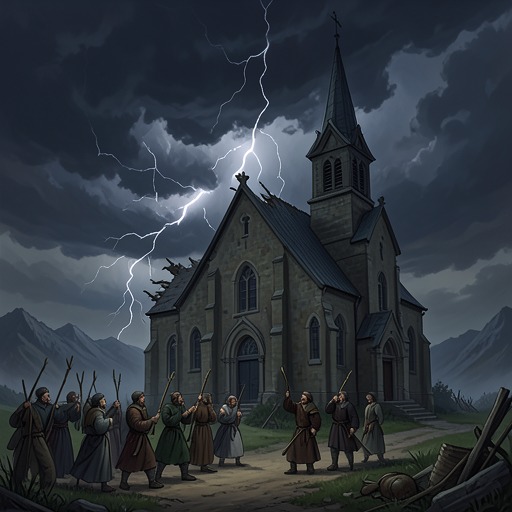
Lockwood's nightmare transforms the sermon into a trial of the congregation itself. In the dream he journeys with Joseph to hear Jabez Branderham preach from the text 'Seventy Times Seven,' and the party is told that either Joseph, the preacher, or Lockwood himself has committed the 'First of the Seventy-First' and is to be publicly exposed and excommunicated. The chapel lies in a hollow between two hills, near a swamp whose peaty moisture is said to embalm the few corpses deposited there, and its clergyman's stipend is only twenty pounds per annum with a two-room house threatening to collapse into one, so that no pastor will undertake the duties. Yet in the dream Jabez has a full and attentive congregation, and he preaches a sermon divided into four hundred and ninety parts, each fully equal to an ordinary address and each discussing a separate sin. Lockwood writhes, yawns, nods, pinches and pricks himself, rubs his eyes, stands up and sits down again, and nudges Joseph to ask whether the preacher will ever finish. When Jabez finally reaches the 'First of the Seventy-First,' Lockwood rises to denounce him as the sinner of the sin that no Christian need pardon, declaring that he has endured and forgiven the four hundred and ninety heads of the discourse, that seventy times seven times he has plucked up his hat and been about to depart, and that the four hundred and ninety-first is too much. Jabez responds with the counter-accusation, 'Thou art the Man!', claiming that seventy times seven times Lockwood gapingly contorted his visage and that the First of the Seventy-First is come. The whole assembly, exalting their pilgrim's staves, rushes round Lockwood in a body, and he grapples with Joseph, his nearest and most ferocious assailant, while blows aimed at him fall on other heads and the chapel resounds with rappings and counter-rappings. The tumult ends only when Lockwood wakes to find that the noise was merely the branch of a fir-tree touching his lattice as the blast wailed by and rattled its dry cones against the panes. The dream thus literalizes the rule of seventy times seven as a machinery of reciprocal accusation, in which the demand for limitless forgiveness becomes the basis for limitless mutual denunciation.
The Rejection of Forgiveness
The dream's parody of forgiveness finds its waking counterpart in Heathcliff's explicit repudiation of the same ethic. When Ellen Dean urges him to forgive the wicked because it is for God to punish them, Heathcliff answers, 'No, God won't have the satisfaction that I shall,' and declares that he only wishes he knew the best way to take his revenge, adding that while he is thinking of it he does not feel pain. The rule of seventy times seven, which commands the victim to absorb injury without limit, is here rejected in favor of a private arithmetic of retribution in which the avenger himself becomes the instrument of punishment. Heathcliff's entire campaign against the Earnshaws and the Lintons, from his return to Wuthering Heights to his systematic usurpation of both houses, is the practical working out of this refusal. Where the biblical rule demands that the injured party cease counting, Heathcliff counts everything: every slight, every deprivation, every act of the tyrant Hindley Earnshaw who calls him a vagabond and threatens to turn him out of the house. The novel thus sets the dream's absurd arithmetic of forgiveness against Heathcliff's grim arithmetic of revenge, and the contrast defines the moral terrain on which the whole story unfolds.
The Rule as Moral Counterpoint
The phrase also resonates through the novel's central relationships, where the language of forgiveness and its refusal marks the deepest bonds and the deepest wounds. Catherine Earnshaw, confessing to Ellen Dean that her love for Heathcliff resembles the eternal rocks beneath, insists that she is Heathcliff and that he is always in her mind as her own being; yet this unity of souls does not produce forgiveness but rather the agony of separation and betrayal. When Heathcliff confronts Catherine about her treatment of him, he tells her that he knows she has treated him infernally, that he will not be consoled by sweet words, and that if she fancies he will suffer unrevenged she will be convinced of the contrary in a very little while. The demand for revenge here is not a departure from his love but its dark mirror: because Catherine is his own being, her betrayal is an injury to himself that no forgiveness can heal. Later, after Catherine's death, Heathcliff's refusal of mercy becomes a refusal of rest itself. Learning that her senses never returned and that she recognized nobody from the time he left her, he cries out that she is a liar to the end, and prays, 'Catherine Earnshaw, may you not rest as long as I am living,' commanding her to haunt him, to take any form, to drive him mad, only not to leave him in the abyss where he cannot find her. The rule of seventy times seven, which would release the living from the dead and the dead from the living, is here inverted into a vow of eternal entanglement. Heathcliff's treatment of Isabella Linton shows the same inversion in its most brutal form: when she writhes under his cruelty, he mutters, 'I have no pity! I have no pity! The more the worms writhe, the more I yearn to crush out their entrails! It is a moral teething; and I grind with greater energy in proportion to the increase of pain.' The language of moral growth is twisted into a celebration of cruelty, and the commandment to forgive is replaced by a commandment to crush.
The Rule and the Novel's Structure
The rule of seventy times seven thus operates on multiple levels of the novel's structure. On the level of plot, it provides the occasion for Lockwood's nightmare, which in turn precipitates his encounter with Catherine's ghost and his demand that she be let in, a moment that frames the entire narrative of the Earnshaws and the Lintons. On the level of theme, it articulates the novel's central moral problem: what happens when the demand for forgiveness is refused, and when the refusal becomes a way of life. The dream's four hundred and ninety parts, each a separate sin, parody the idea that sin can be enumerated and forgiven in installments, just as Heathcliff's revenge enumerates injuries and answers each with a corresponding cruelty. The novel never resolves this tension; instead, it lets the rule of seventy times seven stand as an unattainable ideal against which the characters' failures are measured. The final generations, Catherine Linton and Hareton Earnshaw, find a kind of peace that the older characters could not, but the novel does not present their reconciliation as a triumph of forgiveness so much as a quiet turning away from the arithmetic of revenge. The phrase, with its impossible demand, remains as a haunting reminder of what the characters could not do, and of the cost of their refusal.